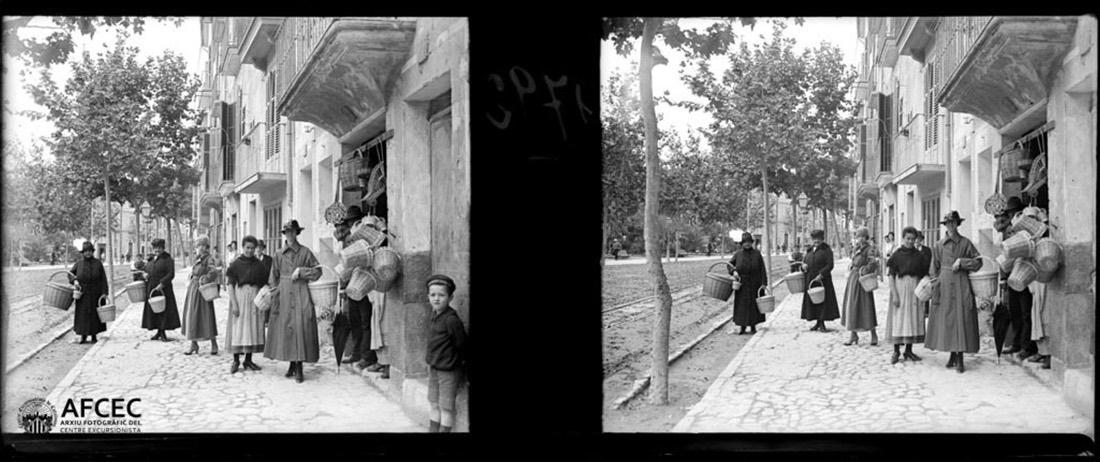
What it is and technique
- Espart: Stipa tenacissima fiber. It is braided or chopped to make ropes, soles, esportins, carrycots.
- Cistelleria: basketry with vímet (wicker), canya, jonc, and in Mallorca especially garballó palm ( obra-de-palma-llata ). The senalla is a shape (bag-basket), not a material.
Short story
Rural occupations of daily use: transportation, harvest, oil mill, fishing. The urban esparteries (Palma, Inca) were the reference store in the countryside.
- The word espardenya derives from espart (esparto footwear), already in Eiximenis, 14th century (DECat).
- 1652: "a bova estora" in a document from Sóller (DCVB): reed mats in the Mallorcan house.
- 1787-1867: the enlightened travelers and the Archduke describe palm basketry as the main domestic industry of Llevant ( obra-de-palma-llata ).
- 1925 Esparteria Beltran (Palma); 1940 Ca'n Toni Blancos (Inca).
- 20th century: plastic replaces signs, esportins and ropes; the trade takes refuge in the store.
- 2017: the baskets in the markets of Mallorca are mainly from Morocco (Mallorca Magazin).
Process step by step
- Espart (general technique, not specifically documented in Mallorca): collect the leaf, dry; espart cru for braiding; espart picat (retting in water and beaten) for fine rope and soles (check in Mallorca). It is braided into pleita (ribbon) and sewn, just like the llata.
- Cistelleria de vímet or canya: frame of poles (costelles) and alternating weaving of wicker or split cane; soaked wicker to bend (general technique).
- Palm: lata braided and spiral sewn. Complete process obra-de-palma-llata .
- Bova: dried and twisted Typha leaf for seats and mats (see cadiraires-i-boga ).
Forms and objects
- Senalla / senalleta: carrycot with two handles; the emblem object.
- Esportí / espartí: esparto disc to press olives or grapes in the oil mill (DECat).
- Estora / estoreta: floor mat (esparto, palm or bova).
- Cowl: large cargo carrycot. Barxa: elongated transport sign.
- Morrió / morrionet: muzzle of the sinia or threshing animal.
- Covo: reed or reed fishing pot (to verify Mallorcan typology).
- Cistell / cistella: wicker or cane basket with handle.
- Espardenya: sewn espart sole (see espardenyes-i-calcat-inca ).
- Corda / cordell: espart, palm or hemp rope (see corderia ).
Vocabulary
- espart: grass (Stipa tenacissima) with tenacious leaves for ropes, baskets, mats and soles.
- espart bord: Lygeum spartum*, albardín.
- esparter / esparteria: who works or sells esparto / his shop.
- pleita: braided esparto grass tape that is sewn to make pieces.
- espartí / esportí: esparto disc for the oil or wine press.
- senalla: carrycot with two handles.
- cofa: large cargo carrycot.
- estora: floor mat.
- bova / boga: enea (Typha); In Mallorca they say bova.
- vímet: wicker.
- canya: cane (Arundo donax).
- cisteller: basket maker.
- cistell / cistella: basket / basket.
- morrió: braided muzzle.
- covo: fishing pot.
- més prim que un bri d'espart: "thinner than a strand of esparto grass" (Majorcan phrase, DCVB).
Geography
- Palma and Inca: commerce (esparteries), as they are rural market centers.
- Levante (Artà, Capdepera) and Ponent (Andratx): palm basketry, where garballó grows.
- Espart: there is no esparto production in Mallorca; It probably always came from the peninsula (Murcia, Almería). Per verify.
- Bova: humid areas (s'Albufera, s'Albufereta) (to verify historical collection).
Xifres
- Esparteria Beltran: since 1925, Comerç Emblemàtic. Ca'n Toni Blancos: since 1940, third generation.
- There is no verified census of esparto or wicker basket makers active in Mallorca. No own BIC declaration (the palm yes, initiated in 2026).
Where and who today
It survives above all as a trade, not as a productive workshop:
- Esparteria Ca'n Toni Blancos — Inca, since 1940, third generation. esparteria-can-toni-blancos
- Esparteria Beltran — Palma, since 1925, Comerç Emblemàtic. esparteria-beltran
- Mimbreria Vidal — Palma, c/ Corderia (cordeleros street). mimbreria-vidal
- The "last basket maker of Mallorca" from Mallorca Magazin (2017) is actually a palm master: Guillem Cassellas (Artà) .
State
At risk as local production. Doubtful: much of the espart sold today is probably from outside the island (not verified; ask the stores).
Contemporary Updates
No verified Mallorcan cases. You have to look for designers who work with local basket makers.
Why is it design
- Fibers without cultivation or energy: leaf, sun and hands. Biodegradable. See proximity design .
- The shape comes from the fiber: ribbon + sewing (esparto grass, palm) or rigid warp + weft (wicker, cane).
- Objects with an exact function: the espartí filters and withstands the pressure of the press; The deceased lets the animal breathe.
- The plastic copied the shapes (the plastic seal) but not the repairability.
For the project
- Possible piece: mapping who really produces on the island (and what is imported) for the atlas; If an active basket maker appears, collaboration on a piece of furniture or container.
- Contact: Toni Ramis (Ca'n Toni Blancos, Inca), Beltran family (Palma), Mimbreria Vidal.
- Basic question: where is the trade when the shops remain but the workshops do not?
Frequently asked questions
What is Esparto and basketry?
- Espart: Stipa tenacissima fiber. It is braided or chopped to make ropes, soles, esportins, carrycots.
Who practises Esparto and basketry in Mallorca today?
The Balearic Islands Crafts Register lists 3 artisans linked to this craft, in Campanet, Manacor, Sant Joan.
What are the traditional words for Esparto and basketry?
Some words: bova / boga, canya, cistell / cistella, cisteller, cofa, covo, espart, espart bord.
Sources
- mallorca.com/ca/directori/empresa/esparteria-can-toni-blancos-inca-w3ewo4gi
- mallorca.com/es/directorio/empresa/esparteria-beltran-palma
- mallorca.com/ca/directori/empresa/mimbreria-vidal-palma-ylpnnzru
- mallorcamagazin.com/nachrichten/gesellschaft/2017/01/17/52056/der-letzte-korbfle
- decat.iec.cat/documents/II/717.pdf
- dcvb.iec.cat/results.asp?word=espart
- dcvb.iec.cat/results.asp?word=bova
- intranet.caib.es/eboibfront/pdf/ca/2026/101/1226130
Working text from the Disseny Indígena knowledge base, machine-translated from Spanish.