What is
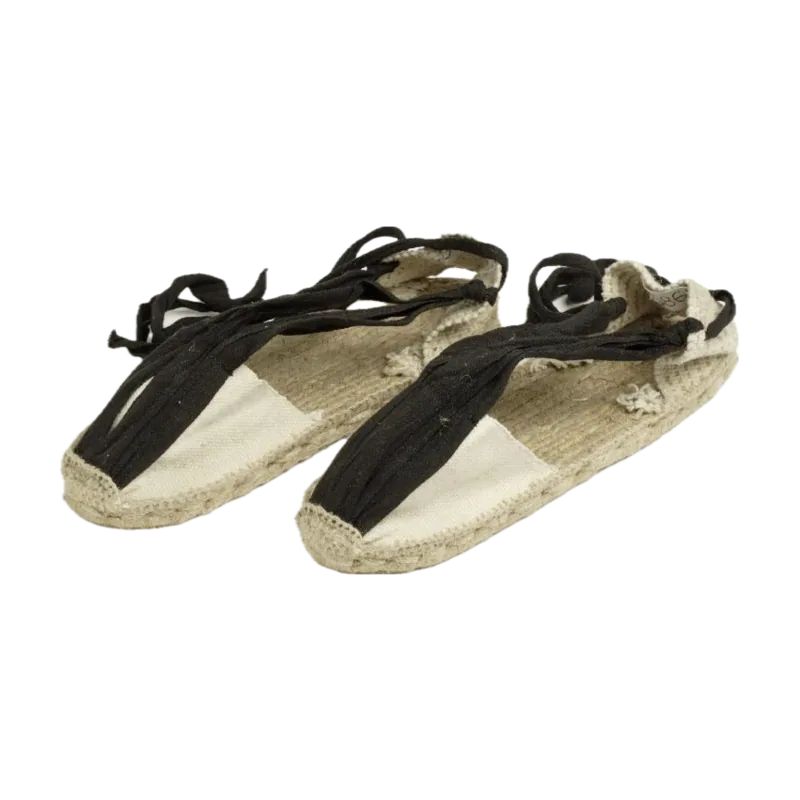
Footwear with espart or braided and sewn canem sole, and fabric upper. It was the light footwear of pagesia. Today it is party shoes (vestit de pagès) and summer.
How is
- Sola: fiber braid (espart, cànem; today often jute) sewn in a spiral.
- Empena: canvas or cloth; sometimes just toe and heel.
- Vetes: ribbons that tie the espardenya to the ankle.
- Mallorcan variant collected by the DCVB: baby espardenya, with a side-to-side strap.
How is fa
- Espardenyer 's job. The fiber is braided, the sole is sewn in a spiral and the upper is sewn by hand.
- Quality regulated since ancient times: an ordinance from 1322 establishes the points for espardenya (26) and the ropes on the foot (11) and on the heel (4); the poorly made ones were burned (DCVB).
- See espart i cistellia and espardenyes i calçat (Inca) .
Com s'usa
- Daily in summer, parties, bot ball. Part of the Blessed's dona and d'home dress.
- It wears out quickly on rocky terrain: that's why it lived with avarques and pigs .
Vocabulary
- espardenya: espadrille.
- espardenyer: who makes or sells espardenyes.
- sola: braided fiber sole.
- empena: fabric upper part.
- veta: ribbon to tie.
- espardenya bebé: with strap from side to side (Mall.).
- «més beneit que una espardenya»: very short of understanding (Mall.).
- «més cremat que una espardenya»: very angry (Mall.).
History
- 13th century: the espardenya already appears in documents; The name comes from espart.
- 1322: ordinance on the quality of espardenyes (DCVB).
- 19th-20th centuries: common footwear of the people; The leather sabata is for parties and the city.
- Today: party and summer fashion shoes; mandatory-recommended in the Blessed.
On veure'n
- Workshops: Esparteria Beltran , Esparteria Can Toni Blancos ; Alpargateria La Concepció (Palma, 1940).
- Museu del Calçat i de la Indústria d'Inca .
- Museum of Mallorca, ethnological section (Wall) .
Why is it design
- Proximity material: local plant fiber, canvas, thread. Compostable.
- Sole that breathes and cushions; ideal for dry heat.
- Quality control codified since the 14th century (number of points).
- Low-cost technology: anyone can do it with a fiber and a needle.
For the project
- Recover a Mallorcan espart espadrille (not imported jute): who still braids espart soles on the island?
- Collaboration with Esparteria Beltran or Can Toni Blancos: reissued “baby” model.
Frequently asked questions
What is Espardenyes?
Footwear with espart or braided and sewn canem sole, and fabric upper. It was the light footwear of pagesia. Today it is party shoes (vestit de pagès) and…
What are the traditional words for Espardenyes?
Some words: empena, espardenya, espardenya bebé, espardenyer, sola, veta, «més beneit que una espardenya», «més cremat que una espardenya».
Sources
- dcvb.iec.cat/results.asp?Word=espardenya
- enciclopedia.cat/art-de-catalunya/les-espardenyes-un-patrimoni-viu
- ajsantamargalida.net/sites/cilma_santa_margalida/files/2025-08/programa-beata%20
Working text from the Disseny Indígena knowledge base, machine-translated from Spanish.