What is
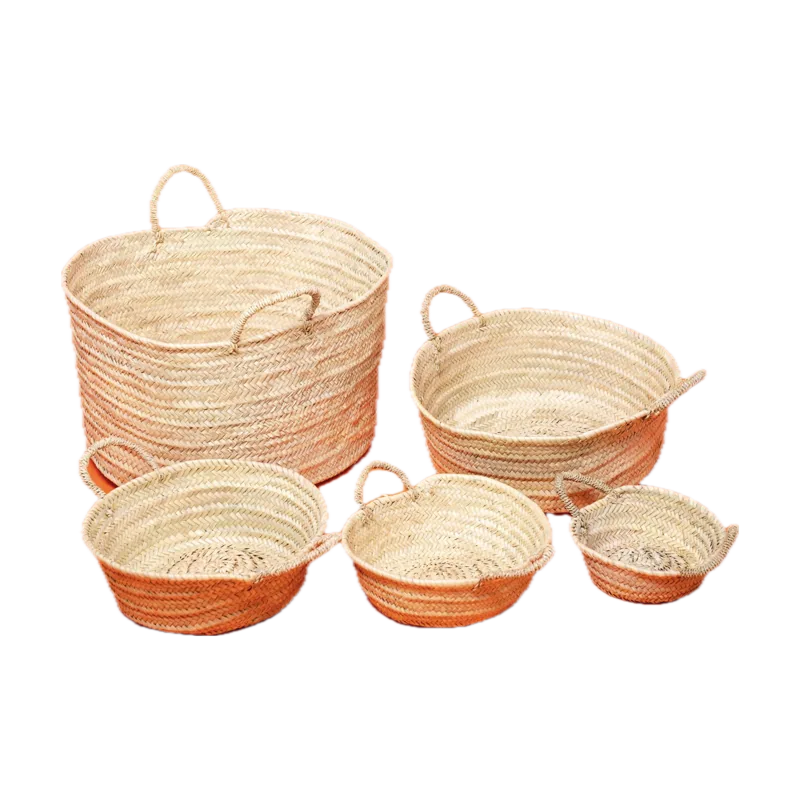
Round and very flat espart bag where the olive paste is placed to press it in the tafona. In Mallorca the usual name is esportí; cofí is a synonym (DCVB) and appears in the Majorcan description of the biga press, but in Majorcan speech cofí primarily names other things:
- Sineu, Artà: very small token to store money.
- Manacor: tin lunch box with lid to carry food.
How is
- Shape: flat espart disc with a mouth in the center ("round bag" shape).
- Material: braided espart; today replaced by synthetic fiber discs (Viquipèdia, "Trull").
- Measurements: not verified for Mallorca.
- Stack: the filled and superimposed esportins form the stack or peu, on the bassi or cofinera of the press (DCVB, "oli").
How is fa
Braided and sewn from espart by esparters. There is no Mallorcan production: the espart came from outside the island (to verify). See espart i cistellería .
Com s'usa
1. The olives ground in the trull are collected and distributed into esportins.
2. The tafoner major forms the pile of esportins under the biga (DCVB, "tafoner").
3. It is pressed: the oli de bigues comes out (first dam, Mall.).
4. The pressing is repeated; Sometimes boiling water is poured into the cofins to extract more oil, of poorer quality (DCVB, "oli").
5. Then they are washed and dried for the next season (please verify). See biga press .
Vocabulary
- esportí: espart disc to press the olive paste (Mall.).
- cofí: synonymous with esportí; in Mallorca, also a money holder (Sineu, Artà) or a lunch box (Manacor).
- pila / peu: column of esportins filled under the press.
- tafoner major: who assembles the pile of esportins.
- oli de bigues: first oil dam (Mall.).
- oli verjo: virgin oil, the one that flows before pressing (Majorcan way).
- «Són com una pila d'esportins de sa tafona»: Alcover comparison (DCVB).
History
- 1287: first records of cofins (for sugar) in the Leuda de Perpinyà (DCVB).
- 14th-15th centuries: the cofí appears as a container for figs, raisins, and fish.
- 1724: "esportins" in an inventory (doc. from Fulleda, DCVB).
- 20th century: hydraulic presses; the espart gives way to the synthetic disc.
On veure'n
- Tafona de Raixa (Bunyola), public property of the Consell (condition of equipment to be verified).
- Can Det (Sóller): family oil mill in use; hydraulic presses and generation “baskets” (commercial source).
- Museum of Mallorca, ethnological section (Wall) (piece to be verified).
Why is it design
- Filter and container at the same time: the espart mesh retains the pulp and allows oil and water to pass through.
- Stackable: flat shape to make a stable column under pressure.
- Pressure resistant: a plant fiber that withstands tons of fiber.
For the project
- Piece: the sport as a graphic object (disc, center, spiral): a lamp, a coaster or a print comes out of it.
- Contact a working tafona to photograph the esportins in use.
- Lexical correction for the atlas: in Mallorca, «esportí» from tafona; "cofí" is something else.
Frequently asked questions
What is Cofí and esportí (esparto baskets)?
Round and very flat espart bag where the olive paste is placed to press it in the tafona. In Mallorca the usual name is esportí; cofí is a synonym (DCVB) and…
What are the traditional words for Cofí and esportí (esparto baskets)?
Some words: cofí, esportí, oli de bigues, oli verjo, pila / peu, tafoner major, «Són com una pila d'esportins de sa tafona».
Sources
- dcvb.iec.cat/results.asp?Word=cof%ED
- dcvb.iec.cat/results.asp?Word=esport%ED
- dcvb.iec.cat/results.asp?Word=oli
- dcvb.iec.cat/results.asp?Word=biga
- ca.wikipedia.org/wiki/Trull
Working text from the Disseny Indígena knowledge base, machine-translated from Spanish.