What is
Two families. Fariner mills have been grinding grain since the Middle Ages. The treure water mills (aiguaders) pump groundwater for irrigation, since the middle of the 19th century. XIX. Mallorca once had the largest concentration of windmills in the world in l'Horta de Palma, more than 70 per km² (Rosselló Verger, cited by Mayol).
##Com works
- Local wind. In summer, the embat: regular sea breeze that blows almost perpendicular to the coast because the interior gets hotter than the sea. Mallorca took advantage of it daily.
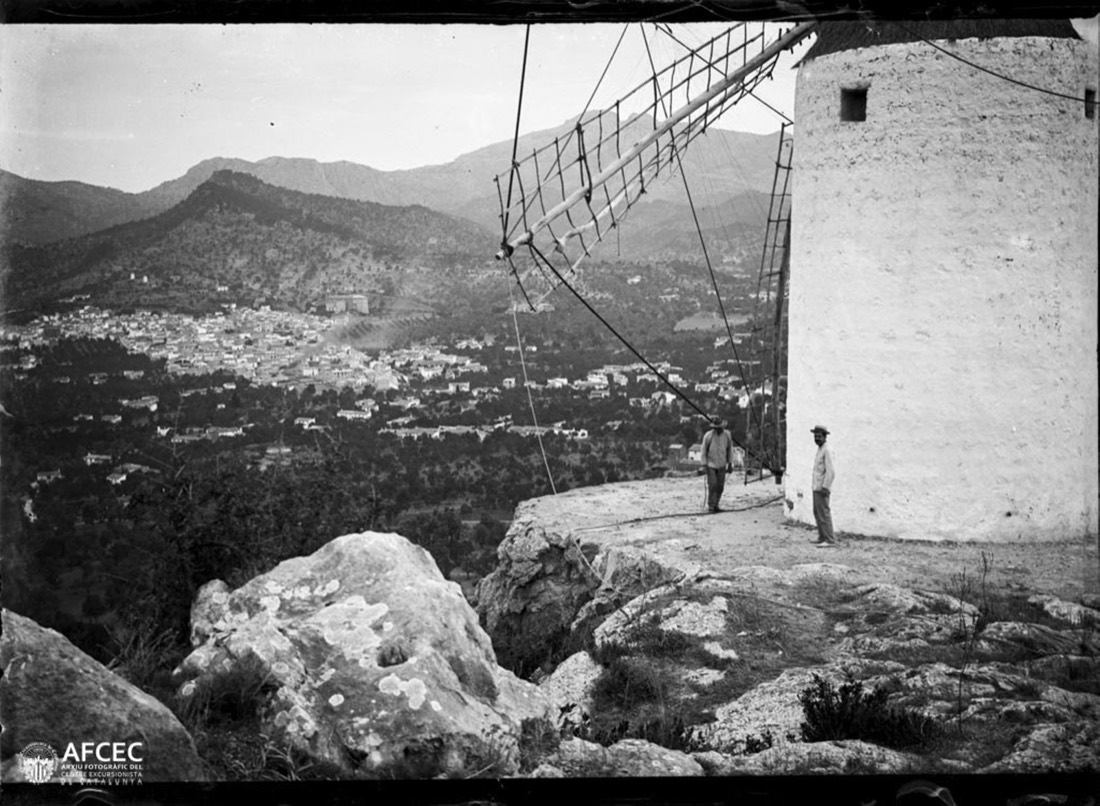
- Fariner: stone tower; Above, the capell rotates to orient the blades; the teeth inside. Mallorcan fariners have six blades, not four (as in Sicily, Malta and Gozo; Pep Pascual).
- De treure aigua: the mill is on a tower built above the well, next to the safareig (pool). The water comes out through a calçada (paved irrigation ditch, somewhat higher than the ground) and is distributed into the furrows.
- Performance: up to 18 m³/hour from 7–8 m deep, to irrigate about 5 quarters (Mayol).
- It requires knowing how to read the weather: stop before a storm, avoid lightning and strong winds. It was dangerous work.
Elements and vocabulary
- molí fariner, molí de treure aigua / aiguader
- veles (canvas), antennas, triangular biases, capell, tower, cintell (solid circular platform), mola
- molí de ramell: fan of 60–100 wooden slats that was opened every day
- pales / ferro grinder: all metal, 1940s
- automatic orientation coa (tail); folding hoist: Mallorcan invention to remove the windmill from the wind
- safareig, calçada, pump, quarterada (7,103 m²)
History
- Fariners: common since the 19th century. XIV. Sa Roqueta (Portitxol, Palma) documented in 1375; It appears in the altarpiece of Sant Jordi by Pere Niçard (1470). Guild of millers documented in 1441. They decline around 1930 with the flour factories. The last one built: Es Molinot (Coll d'en Rabassa, 1935–1963).
- Es Jonquet (Palma): first documented mill in 1339 (Last Hour); seven in the s. XVIII, five today, two in ruins.
- De treure aigua: drying up of the Prat de Sant Jordi (1845–1850) directed by the Dutch engineer Paul Bouvij, with convicts; He installed a paddle mill to draw water. There are previous precedents of little significance (Segura Salado, 2005).
- Local inventors: Mn. Rafel Oliver («capellà de ses idees»), Damià Reixac (wooden bombs, the tail with Oliver), Bernat Rigo «es Cabo Loco» (iron windmills), Martí Barrera de Pòrtol (triangular sails).
- Growth: 56 in 1872 (Arxiduc), 200 in 1890, more than a thousand in 1950. Consell census: maximum of 2,502, 1,112 in Palma (Serrano et al., 2002).
- The model traveled: to Argentina (a son of Reixac), Peru (nuns) and Australia (Majorcan Benedictines).
- Fall: Son Sant Joan airport (hundreds destroyed), urbanization, overexploitation of the aquifer, motor pumps.
On veure'n
- Pla de Sant Jordi and Son Ferriol (Palma): the largest landscape of water mills.
- Es Jonquet (Palma): Molí d'en Garleta, restored in 1995 (Consell–Cort agreement; museum to be verified).
- Molí d'en Fraret (Montuïri), Molí de Son Gornals (Porreres), Manacor mills: open on Consell days (2024).
- Route of the mills of the Pyrenees-Mediterranean Euroregion (Consell, since 2016).
Stat
- Fariners: 895 counted by the Associació d'Amics dels Molins (295 missing); The Consell catalogs 622.
- Aiguaders: less than one hundred operate today (Mayol, 2023). Many are “landscape taxidermy”: decorated, unused.
- About a thousand mills in a radius of ~55 km around Pla de Sant Jordi, most of them private and deteriorated (Última Hora, 2025).
- Consell aid: 2017–2019 call (≈€1.1 M) and 2024–2027 program of €3 M (project and labor; the owner provides license and materials).
- Es Jonquet: BIC neighborhood (historical complex); the private mills, in ruins for more than 20 years.
Why is it design
An object that evolved as a species: sails, ramell, shovels, automatic glue, mutations and selection according to resource and climate (Mayol). Collective, anonymous, iterative design. Lesson: local renewable energy technology that worked for a century. Mayol compares the initial rejection (Brunhes, 1910) with that of today's wind turbines. It is proximity design .
Avui architecture
No architectural reinterpretation identified in the current files. Open countryside: energy and landscape (mill as infrastructure, not decoration).
For the project
- Atlas: evolutionary tree of the aiguaders mills (veles sesgues ramell pales).
- Contact: Associació d'Amics dels Molins de Mallorca; Historical and Industrial Heritage unit of the Consell (Aina Serrano).
- Piece: object or graphic identity with the folding tail as a Majorcan sign.
- Related trades: ferro forjat , marès .
Frequently asked questions
What is Molins de vent (flour and water-pumping windmills)?
Two families. Fariner mills have been grinding grain since the Middle Ages. The treure water mills (aiguaders) pump groundwater for irrigation, since the…
Who practises Molins de vent (flour and water-pumping windmills) in Mallorca today?
The Balearic Islands Crafts Register lists 5 artisans linked to this craft, in Palma.
Sources
- metode.es/wp-content/uploads/2023/09/118ES-6-13-molinos-mallorca.pdf
- ultimahora.es/noticias/local/2020/08/23/1191063/molinos-viento-mallorca-patrimon
- ultimahora.es/noticias/palma/2025/01/28/2305443/molinos-mallorca-mal-estado-moli
- ultimahora.es/noticias/palma/2020/05/31/1169483/molinos-jonquet-patrimonio-pelig
- mallorcadiario.com/consell-y-cort-restauraran-los-molinos-den-garleta-y-son-pere
- illesbalears.travel/en/mallorca/route-of-the-windmills-in-mallorca
- totpla.cat/wp-content/uploads/2024/05/JornadesMolins2024-DEF.pdf
Working text from the Disseny Indígena knowledge base, machine-translated from Spanish.