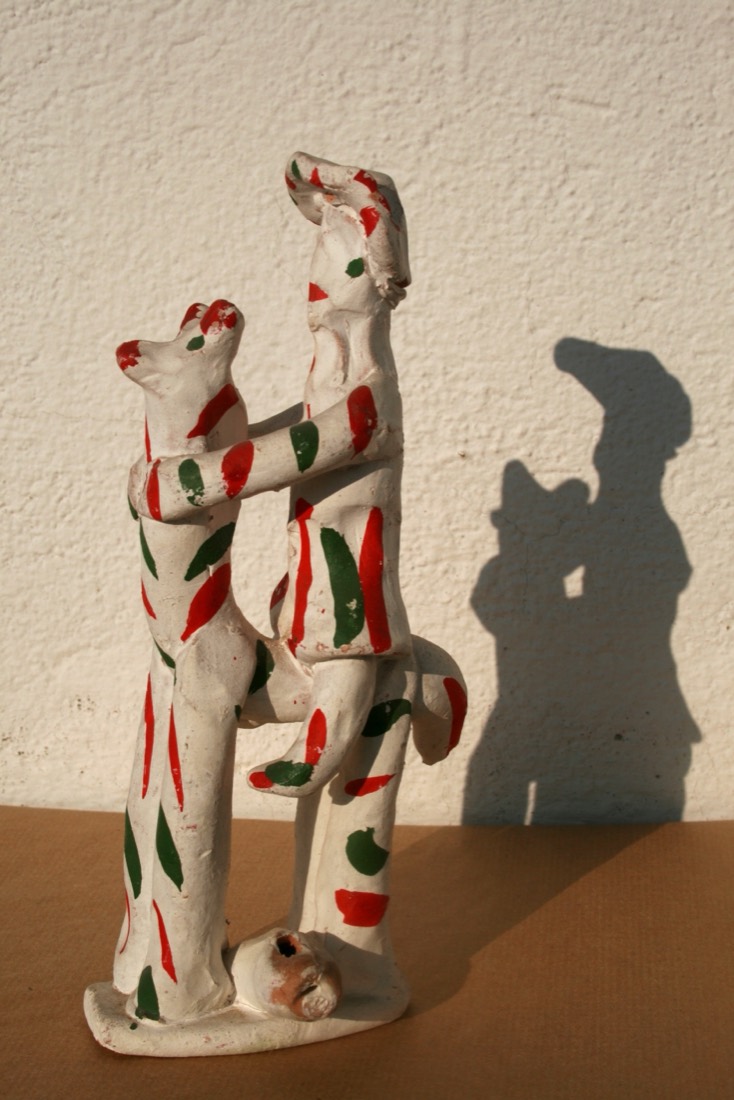
What it is and technique
Clay figurine with a built-in whistle (from siular, to whistle). It is modeled by hand, fired, whitewashed and painted with strokes of red and green (sometimes blue or yellow). Figures: rider, woman, bull, demon, animals.
Short story
Toy and party and market object. Shepherds used them as a decoy, according to Wikipedia (which cites a 2001 ethnographic book). The origin is doubtful: there are stories of ancient origin, but Mallorca Magazin (2011) maintains that they arrive in the 19th century. Joan Miró declared his admiration for the siurells and their influence is visible; the Fundació Miró sells reproductions. I have not verified that Miró had a collection.
- Ancient hypotheses, without proof: Minoan (Carlos Cid Priego, Cerámica popular. Los siurells balearicos, compares with figurines from Crete), Punic or Arab (the peasantry attributed them to the "Moors"). Guillem Rosselló Bordoy studied them: “Silbatos mallorquines” (Al-Andalus, 1957) and Siurells (offprint of the Palma Chamber of Commerce, no. 636, 1962).
- Cautious reading (Coll Conesa 2020): all hypotheses are based on similarities; The reasonable thing is to place the current siurell in the ss. XVIII-XIX, as a local adaptation of a foreign whistle.
- Uses: toy for children from humble families; It was played at festivals, pilgrimages and in the Corpus Christi procession ("breaking the silence" of the Gloria). It was attributed power against the north wind.
- 19th-20th centuries: it is back in fashion (Viquipèdia). With tourism, the pagès-pagesa-dimoni trilogy multiplies up to a hundred forms.
-c . 1950: Elisabet Amengual, “Madò Bet”, models in Sa Cabaneta; origin of the Ca Madò Bet workshop.
- Miró: he said that they had "extraordinary importance" for him (Viquipèdia, quote from Erben, Miró, 2004).
- 2022-2024: research on the siurell inquer (Jornades d'Estudis Locals d'Inca 2024): Inca production has almost disappeared.
Process step by step
Made especially by women (Coll Conesa 2020).
1. Take a portion of clay and model the figure by hand, without a wheel or mold.
2. Glue it to a base made of the same clay.
3. Add the whistle: a piece of clay emptied with a twig, with a hole for blowing and another for air outlet.
4. Dry.
5. Bake in the oven.
6. Whitewash: bathe in hydrated lime, holding the piece by the nozzle, so that that area is clean.
7. Dry the lime in the sun.
8. Cold paint stripes and dots with pigments or anilines in water: reddish red and copper green; rarer, blue and ocher.
9. Today lime is often replaced by plastic paint (hygiene, lime shortage, buyer's taste). Loses the matte and shifting finish of the original.
Size: 7-15 cm (Viquipèdia). Time per piece: no verified data.
Forms and objects
- Traditional trilogy: pagès, pagesa, dimoni.
- Extension (20th century): genet (rider), king genet, genet with caparutxa, dona, dona oferent, confrare (brother), fisherman with boat, pages with Indians.
- Animals: bou, cavallet, gall, hen, indiat (turkey), ca (dog), horses with big horns, donkeys with butterfly wings.
- Bethlehem: all the characters and the portal.
- News of each era: cyclist, motorcyclist, Siurell Vespa and Scooter, airplanes (behind the civil aerodrome).
- Schools: Marratxí (Pòrtol, Sa Cabaneta) and Inca, with their own features (see francisca-truyol-siurells-inca ).
Vocabulary
- siurell: whistle-clay figure; from siular, to whistle.
- xiulell / xiurell / siulet: variants of the name depending on the area.
- siurellera: woman who models siurells.
- siurelleria: craft or workshop of siurells; section of the Fang Museum.
- pito: the part that sounds.
- peana: clay base where the figure rests.
- encalar: bathe in lime.
- calç: lime; gives the white background.
- almagre: red iron oxide.
- verd de coure: copper green.
- pagès / pagesa: peasant, peasant: canonical figures.
- dimoni: demon, the third classical figure.
- genet: rider.
- Siurellada: parade of the Sa Cabaneta festivities with people dressed as siurell.
- romeria: festive pilgrimage, traditional place of sale.
Geography
- Marratxí: Sa Cabaneta and Pòrtol. Same clay and ovens as the ollerias: siurell is born within the clay workshops.
- Inca: own school; nissagues documented since the s. XIX (Madò Tonina Tortella from Can Soleix, Madò Antònia Prats from Can Torrens). Today only one siurellera.
- Consell: Amengual family (Can Bernadí de Consell).
- Traditional sales: fairs and pilgrimages. Typical day: Sant Marçal, June 30, sanctuary of Sa Cabaneta (Viquipèdia).
Xifres
- A hundred documented forms (Coll Conesa 2020).
- 7-15 cm high.
- Inca: 1 active siurellera (2024).
- Ca Madò Bet: Emblemàtic Balear 2024.
- Museu del Fang: collection of siurelleria within more than 900 pieces.
- Prices: without verified data (to verify).
- It is not BIC or UNESCO.
Why is it design
- Minimum of media: a handful of clay, lime and two cheap pigments. An object that sounds, plays and represents.
- Closed graphic language: white background, stripes and dots in red and green. A code recognizable from a distance; That is why it has become an icon (and risk of appropriation).
- Open form: the typology admits current events (motorcycles, airplanes) without losing identity. Tradition as a system, not as a copy.
- Kilometer zero: mud, oven and lime from the same town as the ollerias. See disseny-de-proximitat .
Where and who today
Marratxí (Pòrtol / Sa Cabaneta): Ca Madò Bet dels siurells (Emblemàtic Balear 2024; Madò Bet comes from Can Bernadí de Sa Cabaneta) ca-mado-bet-dels-siurells . Several ollerías make them too. See ceramica-i-gerreria .
- Lineage of Ca Madò Bet (Coll Conesa 2020): Madò Bet Amengual Bestard and Mestre Felip Palou Canyelles; later Francesca Palou and Joan Amengual Serra; today Coloma Cañellas, granddaughter of Madò Bet.
- Other recognized: Sa Roca Llisa olleria (Pòrtol).
- Inca: francisca-truyol-siurells-inca .
State
Alive, sustained above all by the souvenir. Risk: imported industrial copies that are sold as Mallorcans (no verified figure).
Contemporary Updates
It is the most recycled graphic icon on the island (logos, prints). There is a need to find designers who work with siureleros, not only with their image.
For the project
- Possible piece: a new series of siurells (figures of today's Mallorca: deliveryman, tourist, crane) modeled by a siurellera; or a graphic system that pays rights/royalties to the workshop.
- Contact: Ca Madò Bet dels siurells; Fang Museum.
- Background question: is a popular icon for everyone? When is using the siurell a tribute and when is it an appropriation?
Frequently asked questions
What is Siurells?
Clay figurine with a built-in whistle (from siular, to whistle). It is modeled by hand, fired, whitewashed and painted with strokes of red and green…
Who practises Siurells in Mallorca today?
The Balearic Islands Crafts Register lists 10 artisans linked to this craft, in Marratxí, Inca, Palma, Pollença, Santa Maria Del Camí.
What are the traditional words for Siurells?
Some words: almagre, calç, dimoni, encalar, genet, pagès / pagesa, peana, pito.
Sources
- en.wikipedia.org/wiki/Siurell
- miroshop.fmirobcn.org/en/home-decor/1302-siurell-cavall-20-cm.html
- mallorcamagazin.com/nachrichten/lokales/2011/02/24/9385/topf-und-topfer.html
- illesbalears.travel/en/mallorca/the-route-of-pottery-in-portol
- caib.es/webgoib/-/les-olleries-de-marratx%C3%AD-reben-el-distintiu-d-emblem%C3%A
- ca.wikipedia.org/wiki/Siurell
- contents.idi.es/images/documents/Catalogo_XII_Jornadas_Baleares_20.pdf
- ibdigital.uib.es/greenstone/library/collection/jornadesEstudisLocalsInca/documen
- mallorca.com/es/guia/lugares-de-interes/museu-del-fang
Working text from the Disseny Indígena knowledge base, machine-translated from Spanish.