What is
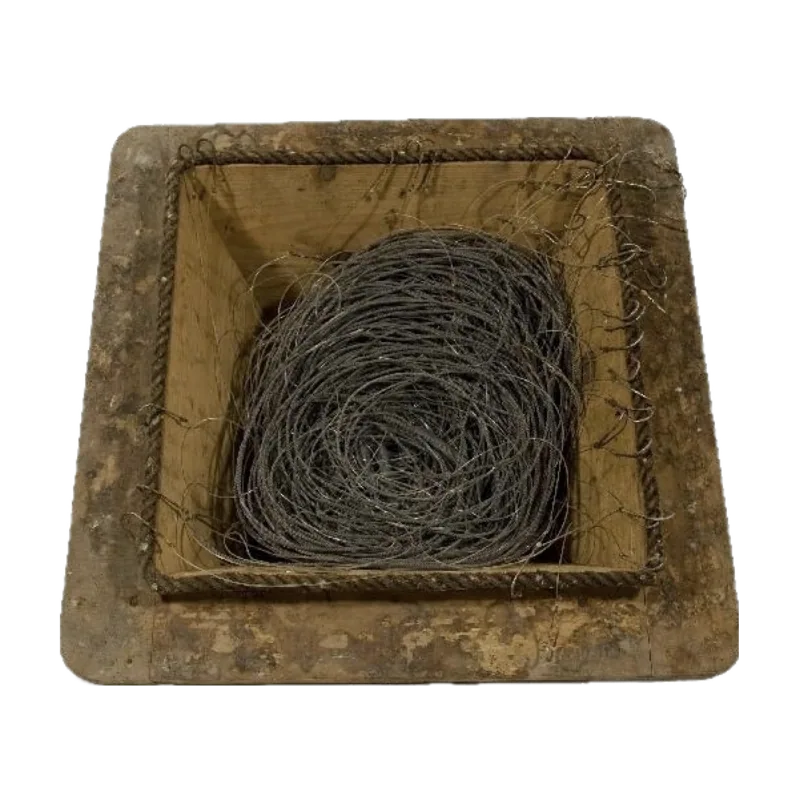
Fishing art with hooks: a long anchored line (the main llença) from which thinner and shorter lines hang, each with its ham. It is used throughout the coast, from l'Empordà to Alacant and in the three Balearic Islands (DCVB).
How is
- Llença mare: main line. In Mallorca and Menorca the longline consists of ten spliced lines, 150 braces in total (DCVB).
- Braçolades: short lines that hang from the main one, with the hook.
- Hams: from 2-3 cm (braçolí longline) to 8-12 cm (anphos longline).
- Capcers: at each end, a line goes down from the bottom (lead or stone) to the surface (cork or pumpkin). The capcer is called gall; At night a picarol is hung on it to find it in the dark (Mall.).
- Types: d'anfós, de déntol, pagre (or mitja bordera), congres (cotton braçolades so they don't cut them), menuda, braçolí, pèl (horse hair).
- Escàlem (Mall., also): espart seal with a lid lined with tarpaulin where the tackle is stored (DCVB, general meaning; Mallorcan use to be verified).
How is fa
It is put together by the fisherman himself: he cuts braçolades, ties hams, splices llences. Ropes and fil of the corders ( corderia ). Today, nylon monofilament (please verify date of change).
Com s'usa
1. On land, hook by hook is fished (baited) and the hooks are attached to the tag without getting tangled.
2. It starts from the llaüt, advancing slowly, from capcer to capcer.
3. Leave it for a few hours (often overnight) and remove it, unhooking the fish.
4. The llaüt that uses it is also called palangrer.
Vocabulary
- palangre: hooking gear on an anchored line.
- palangrer: longline fisherman; longline llaüt (Bal.).
- llença: line, fishing line.
- braçolada / braçol: short line with hook.
- ham: hook.
- capcer: buoyed end of the longline.
- gall: the capcer (Mall.).
- picarol: gall rattle to find it at night (Mall.).
- esca: bait.
- «D'ací a costa hi ha tres palangres»: about 450 strokes: the longline is a measure of distance in the sea (Mall.).
History
- 1374-1375: longliners in Barcelona documents (DCVB).
- 1398: in Mallorca a place is assigned to beach "the lauts dels bolentins y palangres" (BSAL, cit. DCVB).
- 20th century: nylon replaces cotton and horsehair (to verify).
- Today: bottom longlining remains among the minor arts of the Balearic fleet (Oceana, 2014).
On veure'n
- Maritime Museum of Mallorca (Palma); Museum of the Sea (Port de Sóller) (pieces to be verified).
- Ports with minor gear fleet: Portocolom, Cala Rajada, Port de Sóller, Porto Cristo (ask at the confraria).
Why is it design
- Modular system: ten equal parts joined together; They are added or removed depending on the fishing ground.
- Measurement and tool at the same time: the longline measures distances at sea.
- Selective by design: the hook size decides the species.
- Night interface: a bell as a signal in the dark.
For the project
- Graphic piece: the longline as a unit of measurement of the sea (map of “longline” distances of a cove).
- Interview with a longliner from Portocolom or Cala Rajada for the atlas.
Frequently asked questions
What is Palangre (longline)?
Fishing art with hooks: a long anchored line (the main llença) from which thinner and shorter lines hang, each with its ham. It is used throughout the coast…
What are the traditional words for Palangre (longline)?
Some words: braçolada / braçol, capcer, esca, gall, ham, llença, palangre, palangrer.
Sources
- dcvb.iec.cat/results.asp?Word=palangre
- dcvb.iec.cat/results.asp?Word=palangrer
- dcvb.iec.cat/results.asp?Word=esc%E0lem
- oceana.org/wp-content/uploads/sites/18/OCEANA_Illes_Baleares_03_Pesca_Artesanal_
Working text from the Disseny Indígena knowledge base, machine-translated from Spanish.