What is
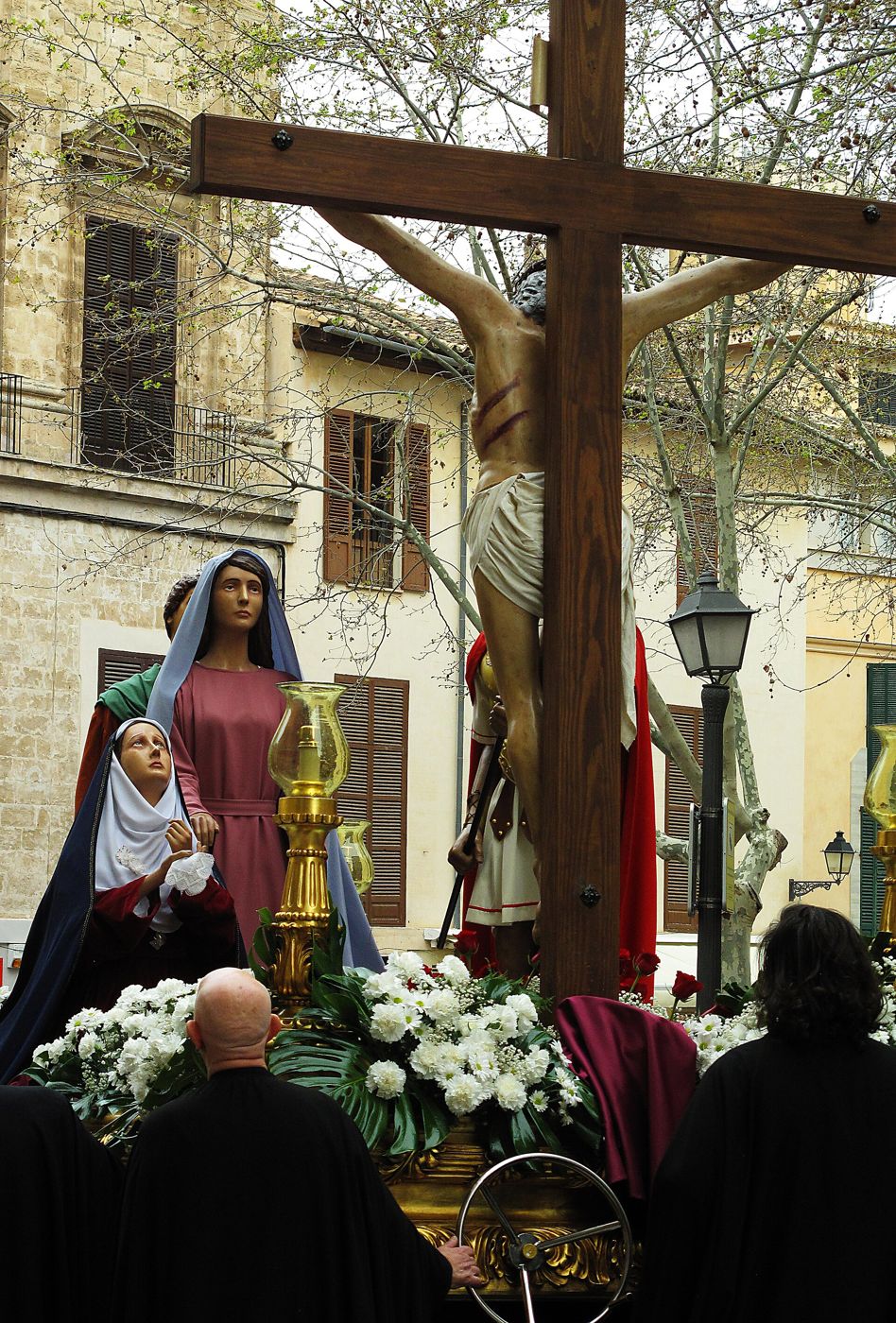
The two strongest images of Majorcan Holy Week: the procession of Sant Crist de la Sang in Palma (Holy Thursday) and the Davallament de Pollença (Good Friday), the descent of Christ down the stairs of Calvari.
On i quan
- Palma, Holy Thursday, 7 p.m., from the church of l'Anunciació (la Sang). It can end at dawn (4 hours in 2023).
- Pollença, Good Friday night, Calvari.
- Other davallaments: Artà, Sineu, Felanitx, Son Servera.
Personatges and objects
- Penitential confraries (33 in Palma) with capirot and vesta capirot i vesta .
- Prohomonia de la Sang: go down and carry the image; without hood or tunic.
- Steps (images); noisemakers that replace bells noisemakers .
- Carapunats: hooded penitents throughout the island.
- Ciris (candles) and torches.
How is
- Palma: the Sang closes the order of processions towards the Seu.
- Pollença: the image of Christ is unnailed from the cross and the procession is carried down the 365 steps of Calvari to the church, by torchlight.
Vocabulary
- davallar / Davallament: go down; the descent.
- capirot: conical hood.
- carapunat: hooded penitent.
- confraria: brotherhood.
- prohoms de la Sang: brothers who carry the Christ.
History
- 1456: General Hospital; the image is linked to it from the beginning.
- 1554: first documentation of the Sang procession.
- 1564: the Sang brotherhood organizes it to collect alms for the Hospital.
- 19th century: guilds disappear in processions. 20th century: the current brotherhoods are born.
- 1650: date attributed to the Davallament of Pollença (disclosure source; to be verified).
Protection
- No BICIM declaration located (to verify).
Why is it design
- Designed anonymity: the hood hides the penitent; Penance is not exhibition.
- Architecture as a setting: the 365 steps are the route of the ritual.
For the project
- Vestas and capirots workshop: who sews them in Palma.
- Read the UIB work on the origins of Holy Week in Palma.
Frequently asked questions
What is Holy Week: the Sang de Palma and the Davallament of Pollença?
The two strongest images of Majorcan Holy Week: the procession of Sant Crist de la Sang in Palma (Holy Thursday) and the Davallament de Pollença (Good…
What are the traditional words for Holy Week: the Sang de Palma and the Davallament of Pollença?
Some words: capirot, carapunat, confraria, davallar / Davallament, prohoms de la Sang.
Sources
- mallorcadiario.com/procesion-crist-de-la-sang-palma-semana-santa-2025
- mallorcamagazin.com/nachrichten/kultur/2024/03/25/120107/der-karwoche-gehen-die-
- mallorca.com/ca/guia/lugares-de-interes/carrer-del-calvari
- dspace.uib.es/xmlui/handle/11201/162142
Working text from the Disseny Indígena knowledge base, machine-translated from Spanish.