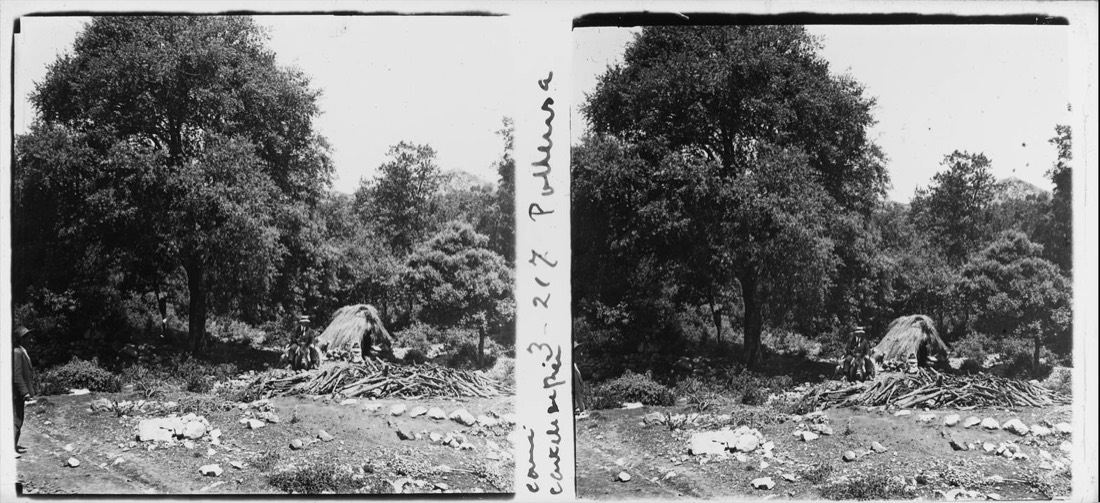
What it is and technique
The forn de calç cooks limestone at more than 1,000 °C for days. The stone turns into quicklime. With water it is quenched and gives lime for mortar, for whitewashing and for the field. The calciners built the oven, loaded it, monitored the fire and emptied it.
Short story
- Marginal industry at the beginning: self-consumption and exchange, in mountain corners not suitable for cultivation.
- Agreements "to use and custom", without papers: there is almost no written documentation of the ovens.
- Around 1900: time of greatest activity, judging by the number of ovens inventoried.
- 20th century: Portland cement and tourism put an end to the trade.
- 1989: Gabriel Valero, “Forns de calç i calciners” (Elements of the Majorcan pre-tourist society).
- 1995: G. Ordinas, Els forns de calç a Santa Maria.
- 2021-2022: Pere Llofriu would inventory Puigpunyent, Calvià and Palma (BSAL 2022).
- 2025: the Consell announces an inventory of ethnological elements of the Tramuntana (starting with sources, scars and possessions).
Process step by step
1. Build the oven on a hillside, near stone and firewood: excavate the pot (cylinder, the bottom cut into rock) and cover the part with earth (caixa).
2. Enfornar: inside a volta of large stones is mounted, with holes for the flame to pass through. Above, limestone ("living stone"). It is covered with dead lime or earth.
3. Lighting: fine wood is placed under the volta.
4. Cooking: the stone is kept at about 1,000-1,200 °C for 10-12 days (other sources: 9-15), feeding non-stop with bundles of firewood.
5. Cool and unmold: remove the quicklime through the portell.
6. Protect the lime from water with reeds and branches; transport by car.
- Firewood: bundles of low pine branches (from pruning) and oak.
Forms and objects
Typology of the Mallorcan oven (Llofriu, BSAL 2022):
- Forn de replà: on a landing; complete tape. Infrequent.
- Forn sobirà: portell at the high altitude; back like turret. The most attractive.
- Forn jussà: portell at the lower level; the oven sinks into the hillside.
- Lateral forn: portell to one side; sometimes with “cintell de talaiot”.
- Forn encastat: pot completely cut into rock, like a well.
- Next door: calciner hut, cart paths, firewood landings.
Vocabulary
- calciner: who makes the lime (originally, who ran the business).
- forn de calç: lime oven.
- olla: excavated cylinder, oven chamber.
- cul de l'olla: rock bottom.
- caixa: interior wall that covers the pot.
- cintell: exterior wall on slope.
- cantells: radial walls that limit the entrance.
- portell: opening for loading and emptying.
- enfornadora / lleó: large stone at the base of the portell that directs the flame.
- volta: stone vault over the hearth.
- pedra viva: limestone to be fired.
- calç viva: calcium oxide.
- calç morta / amarada: slaked lime.
- emblanquinar: whitewash.
Geography
- Serra de Tramuntana and mountains of Palma, Calvià, Puigpunyent, Esporles, Santa Maria, Bunyola.
- Logic: limestone + forest in the same place; The oven is placed where the car arrives.
- Signposted visitable ovens: Escorca, Sant Elm; eight restored in the Commune of Bunyola (2023-2025).
Xifres
- Ovens inventoried by municipality: Calvià 132, Palma 95, Santa Maria 55, Puigpunyent 50, Esporles 40 (Llofriu 2022).
- Production per batch: 100-150 t of lime (disclosure source; to be verified).
- Cooking: 10-12 days at 1,000-1,200 °C.
- There is no official island total (to verify with the Consell).
Why is it design
- Architecture without plans: it was resolved on the ground, with clear typologies according to the slope.
- Local chemistry: stone and firewood from the same mountain, lime for the town houses.
- Lime = healthy material: breathes, disinfects (wine, stables, houses).
- Today artisanal lime returns in bioconstruction: an opportunity for proximity .
- Related: pedra-en-sec , carboners-i-sitges .
State
Context: extinct trade; ovens as heritage and landscape. No artisanal lime producers identified in Mallorca (to verify).
For the project
- Possible piece: map of kilns in the atlas (drawn typologies); lime pigment/finish with a bioconstruction study.
- Contact: Pere Llofriu (inventories); Consell (ethnological inventory of the Tramuntana); Bunyola Town Hall (restorations).
- Background question: can lime become a local design material again?
Plugin (merged tab on 10/13/2026)
What it is and technique
Live calç production by firing limestone in stone kilns in the forest. It was made by the calciners, in seasons, along with carboners and llenyaters. Lime was used for mortar, plastering, whitewashing houses, waterproofing cisterns and disinfecting.
Short story
- Ancient chemical principle (lime mortars in Asia Minor from about 14,000 years ago, according to Viquipèdia).
- In Mallorca, hundreds of ruins of ovens in the Serra de Tramuntana; important production until the middle of the 20th century (Viquipèdia; exact number of ovens to be verified in the IPAIB or municipal catalogues).
- The oven was rented to crews of calciners; The initiative came from the mestre calciner or the owner of the estate.
- Disappears with Portland cement and industrial lime. Today the ovens are ethnological heritage and excursion stops (Escorca, Sant Elm, Calvià...).
Process step by step
1. Choose a place: hillside with abundant limestone and firewood, usually in holm oak woods.
2. Build: hole about 2 m deep and 4 m in diameter; dry stone box with clay joints.
3. Prepare firewood: it is cut months before into bundles (feixos, fogots). Total preparation, about 3 months from January-February.
4. Enfornar: large stones below forming the vault (voltes), small ones above (curull); It is closed with the capell of lime and mud.
5. Coure: continuous fire for 10-15 days, at 800-1000 °C, putting firewood through the mouth with the gavell. It cannot be stopped until the master decides that it is cooked: whitish stone and missing joints.
6. Refredar i desenformar; sell the fired stone whole or quenched.
- Season: April to September (humidity spoils the batch). The calciners lived in barracks next to the oven.
- One batch: between a month and a month and a half of work.
Forms and objects
- Forn de calç: stone cylinder half buried in the hillside.
- Calciner hut: dry stone shelter next to the oven.
- Calç viva (baked stone) and calç amarada (quenched with water, in paste).
- Uses: lime morter, arrebossat, emblanquinat of facades and patios, coating of cisterns and safareigs, sulphating and disinfection.
Vocabulary
- calç — cal.
- calç viva — fired, unslaked limestone.
- calç amarada — lime slaked with water.
- calciner — who makes lime.
- forn de calç — lime oven.
- pot — lower hole where the firewood burns.
- mouth — opening to put firewood.
- cover — wall that closes the oven box.
- enfornadora — stone in the lower part of the mouth.
- voltes — large stones that form the cargo vault.
- curull — finishing of small stones above.
- capell — layer of lime and mud that covers the oven.
- spiral / fumera — smoke outlet.
- gavell — gallows to put firewood.
- feix / fogot — bundle of firewood.
- whiten — whiten with lime.
(Terms from Viquipèdia, partly from Eivissa/Formentera; Mallorcan use to verify in DCVB.)
Geography
- Serra de Tramuntana (Escorca, Sóller, Andratx/Sant Elm, Calvià…): limestone and oak forest together; The oak provides dense firewood for long burning.
- The oven went to the forest because moving firewood cost more than moving stone.
Xifres
- 800-1000°C; 10-15 days of continuous fire; 2 m x 4 m hole (Viquipèdia, general information).
- Number of ovens in Mallorca: to be verified (an island inventory has not been located).
- Last oven turned on in Mallorca: to verify.
Why is it design
- Ephemeral and reusable architecture: the oven is remade with the same stone; the load is at the same time structure.
- Circular material: lime becomes limestone again when carbonated; breathes, disinfects and repairs itself.
- Designed landscape: oven, hut, path and holm oak forest form a productive system in the mountains.
- The Mallorcan white of patios and facades comes from here: visual identity made with a local material.
- See proximitat and stone design in sec .
Where and who today
- Without active traditional production located in Mallorca. Visitable ovens: Escorca (Tramuntana route), Sant Elm, Calvià (municipal ethnographic heritage).
- Demonstrative recoveries or ignitions: to verify.
State
Disappeared as a profession. Ethnological heritage in ruins, many covered with vegetation. Artisanal lime returns in the restoration of buildings (imported lime; local production to be verified).
For the project
- Possible piece: map of lime kilns from the atlas; series of photos of lime white on facades.
- Collaboration: restorers and architects who work with lime mortars in Mallorca.
- Background question: a seasonal job that designed the landscape of the Serra and the color of the towns.
Sources
See frontmatter.
Frequently asked questions
What is Calciners and lime kilns?
The forn de calç cooks limestone at more than 1,000 °C for days. The stone turns into quicklime. With water it is quenched and gives lime for mortar, for…
What are the traditional words for Calciners and lime kilns?
Some words: caixa, calciner, calç morta / amarada, calç viva, cantells, cintell, cul de l'olla, emblanquinar.
Sources
- spain.info/es/destino/calvia/
- ca.wikipedia.org/wiki/Forn_de_calç
- ibdigital.uib.es/greenstone/sites/localsite/collect/bolletiSocietatLulliana/inde
- masmallorca.es/ca/productes-tipics/forns-de-cals-i-els-calciners-mallorca.html
- mallorca.com/ca/guia/lugares-de-interes/forn-de-calc-escorca
- mallorca.com/ca/guia/lugares-de-interes/forn-de-calc-sant-elm
- foravila.net/area/serra-de-tramuntana/bunyola-ja-duu-vuit-forns-de-calc-restaura
- dbalears.cat/balears/balears/2025/02/25/403273/consell-mallorca-fara-inventari-t
- ca.wikipedia.org/wiki/Forn_de_cal%C3%A7
Working text from the Disseny Indígena knowledge base, machine-translated from Spanish.