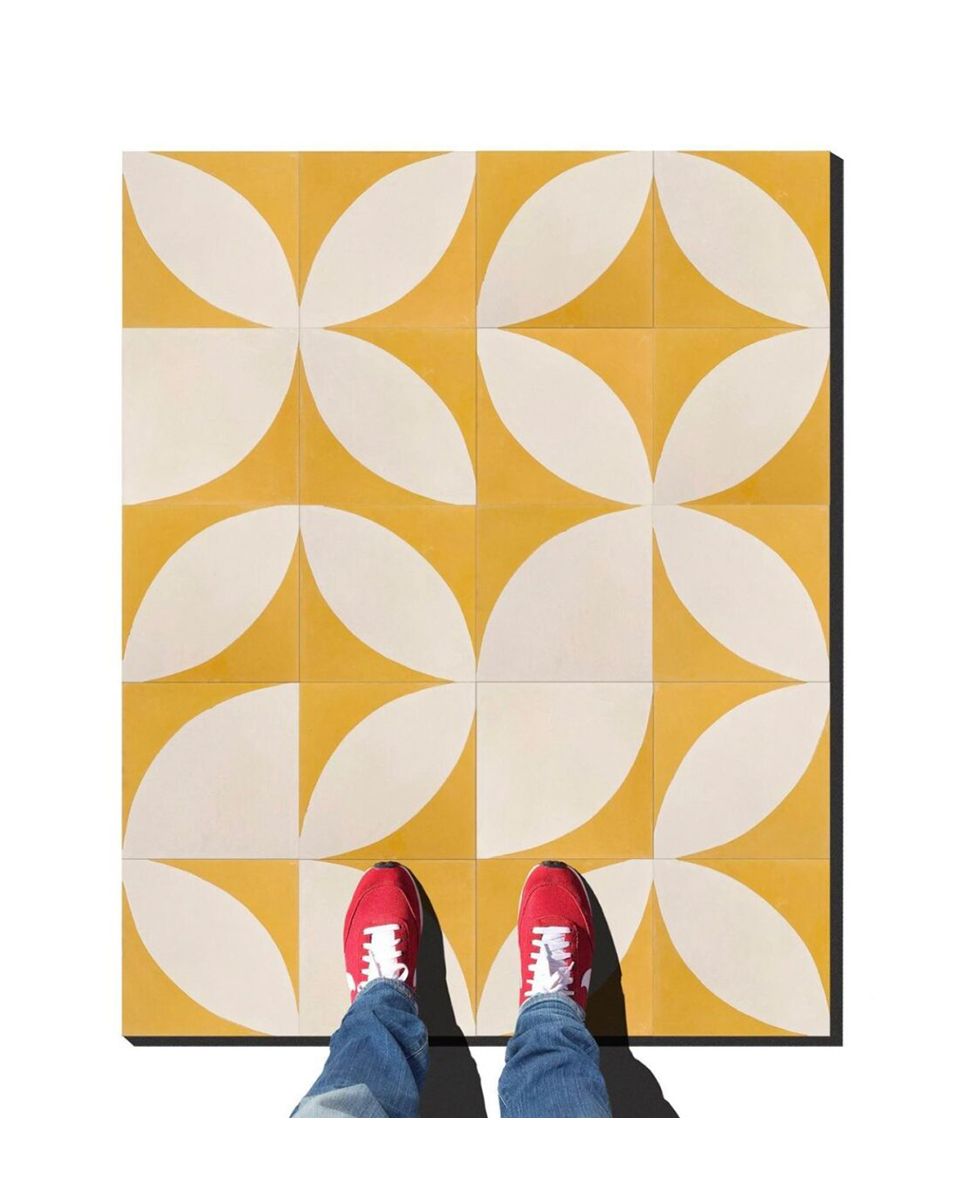
What it is and technique
Uncooked cement tile. The color layer (cement, marble powder, pigments) is poured into a metal mold with climbers that separate the colors; on top, layers of dry mortar; It is pressed with a hydraulic press and cured with water. Mallorca has its own motifs and palettes in town and modernist houses.
Short story
- Origin around 1857; It was unveiled at the Universal Exhibition in Paris in 1867 as a tile that did not require cooking and was forged under a hydraulic press (hence the name). Golden age: late 19th century and early 20th century, with modernism.
- Spain once had more than a thousand factories. In Mallorca, almost every town had its own: more than 100 workshops until the middle of the 20th century (Homo Faber).
- Years 1960-1970: cheaper stoneware replaced them; most close or are converted (cement beams and vaults).
- 1933: Gabriel Huguet founded Huguet in Campos. During the tourist boom he continued making cement beams and vaults; participates in the construction of Can Lis and Can Feliz by Jørn Utzon.
- Biel Huguet, grandson and architect, relaunches the hydraulic rajola with contemporary design (2000s; exact date to be verified).
- Small revival since the 2010s in renovations and new construction.
Process step by step
1. Metal mold (motlle) with a climb: brass or metal grid that separates the colors of the drawing.
2. View layer: fluid paste of white cement, marble powder, fine sand and pigments; Color by color is poured into each compartment (in Huguet, with a pastry bag).
3. The climb is removed; The colors remain next to each other without mixing.
4. Bottom layer: dry cement and sand mortar that absorbs water from the exposed layer.
5. Premsat: high pressure hydraulic press. Without oven.
6. Desemmotllat and curat: immerse or water with water and let it harden in the air for about two weeks.
7. Finishing: on site it is polished and sealed; Unsealed it is soft and stains. Clean with neutral soap, never acids.
- Rhythm: a multicolor mosaic of 20 x 20 cm, maximum 3 m² per day (Huguet, 2013).
Forms and objects
- Rajola 20 x 20 cm, the standard size (also 15 x 15 and 25 x 25, please check in Mallorca).
- Catifa: central cloth with a drawing that imitates a carpet.
- Border: perimeter band that frames the catifa.
- Sòcol / corner piece: edge and corner pieces.
- Plain Rajola: single color, to fill.
- Motifs: geometric, floral and modernist scrolls; stars, rhombuses, checkerboard.
- Derivatives in Huguet: handmade terrazzo, cement beams and vaults, custom pieces.
Vocabulary
- rajola hidràulica: pressed cement tile, without firing.
- mosaic hidràulic: synonym used in Catalonia.
- rajola: tile in general.
- rajoler: who makes rajoles.
- rajoleria: rajoles workshop.
- trepa: metal grid that separates the colors.
- motlle: metal mold of the piece.
- premsa: hydraulic press.
- capa vista: colored layer, the one that is stepped on.
- pols de marbre: marble dust from the visible layer.
- ciment blanc: base of the color layer.
- pigment: oxides that give color.
- adobar: cure with water (per verify use in Mallorca).
- catifa: carpet-like central composition.
- cenefa: decorative border strip.
- trespol: floor of a room (in Mallorca).
- terratzo: cement pavement with marble china.
Geography
- Before, factories in almost every town (cement, sand and marble easy to transport; local demand).
- Today: Campos (Huguet) and Lloseta (Pavimientos Lloseta; own production according to the press in 2013, current activity to be verified).
- Campos also concentrates teulera and rajoleria: construction material tradition of the Migjorn.
Xifres
- More than 100 workshops in Mallorca until the middle of the 20th century (Homo Faber).
- 2 own producers in 2013: Huguet and Pavimientos Lloseta (Mallorca Magazin).
- 2013 indicative price: €40-100/m² depending on drawing and colors.
- Production: up to 3 m²/day in multicolor mosaic.
- Huguet: founded in 1933; third generation.
Why is it design
- Without oven: forging by pressure and water; less energy than fired ceramic.
- The drawing is the material: the color is several millimeters thick; It is worn without losing the drawing and can be repolished.
- Modular system: few pieces (plain, catifa, border, corner) make up infinite rugs.
- Open tool: the climb allows new drawings with the same process; That is why architects and designers (Herzog & de Meuron, Chipperfield, Urquiola, Häberli...) work with Huguet.
- Proximity: village factory that serves local and international architecture. See proximity design .
Where and who today
- Huguet — Campos (Camí Vell de Ciutat 33). Founded in 1933 by grandfather Gabriel; today Biel Huguet, third generation. Hydraulics and terrazzo by hand, custom orders, visits. huguet
State
I live, thanks to the demand for architecture and design.
Contemporary Updates
Huguet is the great case of local craft in international architecture. Homo Faber cites collaborations with Herzog & de Meuron, David Chipperfield, Barozzi Veiga, Martínez Lapeña-Torres, Lluís Clotet, Carme Pinós, Alberto Lievore, Sybilla, Alfredo Häberli, Caruso St John, Patricia Urquiola and Sergison Bates. Award associated with Mies van der Rohe (2015; German press data, to be verified).
For the project
- Possible piece: rajola with new drawing derived from the atlas (siurell motifs, llengües steal, reixes); designer × Huguet collaboration.
- Contact: Biel Huguet.
- Background question: how a town factory becomes a world reference without leaving the town.
Frequently asked questions
What is Rajoles hidràuliques (hydraulic cement tiles)?
Uncooked cement tile. The color layer (cement, marble powder, pigments) is poured into a metal mold with climbers that separate the colors; on top, layers of…
Who practises Rajoles hidràuliques (hydraulic cement tiles) in Mallorca today?
The Balearic Islands Crafts Register lists 4 artisans linked to this craft, in Campos, Felanitx, Inca.
What are the traditional words for Rajoles hidràuliques (hydraulic cement tiles)?
Some words: adobar, capa vista, catifa, cenefa, ciment blanc, mosaic hidràulic, motlle, pigment.
Sources
- mallorca.com/es/directorio/empresa/huguet-rajoles-hidrauliques-s-l-campos
- mallorcamagazin.com/service/leben-und-arbeiten-auf-mallorca/wohnwelten-haus-und-
- mallorcamagazin.com/nachrichten/wirtschaft/2018/09/21/64707/lange-out-jetzt-hip-
- port-magazine.com/?p=87361
- homofaber.com/en/artisans/huguet-tile-making-spain
- mallorcamagazin.com/service/leben-und-arbeiten-auf-mallorca/wohnwelten-haus-und-
Working text from the Disseny Indígena knowledge base, machine-translated from Spanish.