What is
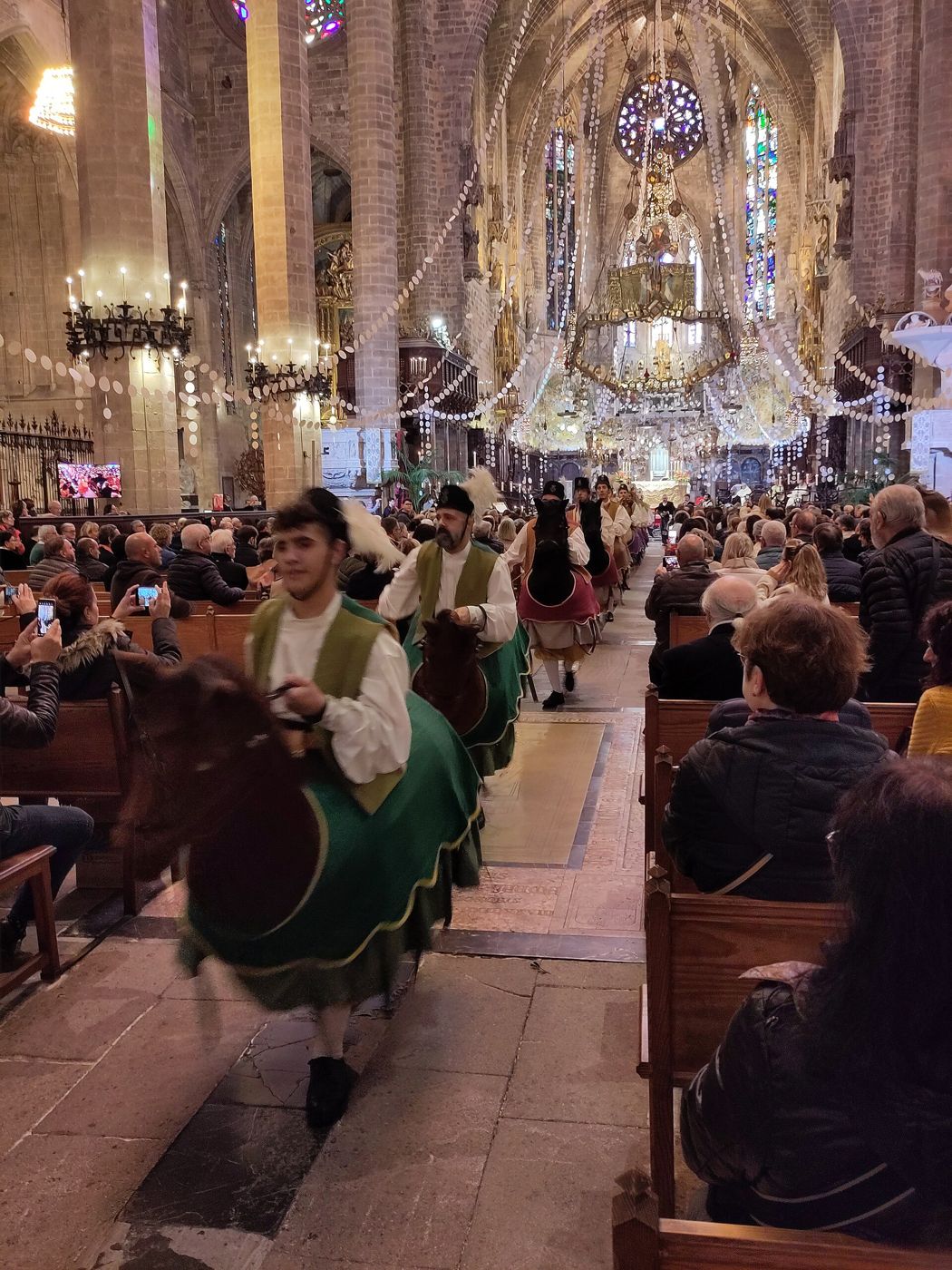
Six children with a horse around their waist and a Lady who guides them with an embroidered handkerchief. They descend from the cavalls cotoners of Corpus.
On i quan
- Felanitx: Santa Margalida (July 19-20) and Sant Agustí (August 27-28).
Personatges and objects
- 6 cavallets and the Lady cavallet .
- Dimonis and caparrots in the parades caparrots i gegants .
- Music: xeremies , flabiol and drumí.
How is
- Cavallets: espardenyes and long socks; white panties puffed below the knee with red trim and bells; red tunic with white trim and buttons; green cap with the left brim raised and held with a tuft; the horse at the waist.
- Lady: white espardenyes with rosette, white stockings, skirt and white petticoat with lace (about five); green tunic with lace; red hat with raised brim. Sprig of alfàbega on the left; On the right, a tatting mocador with which he beats the beat and gives the entrances.
- The cavallets always look at the Lady. Children from 10 to 13 years old.
- Dances: els Canvis, el Pas Nou, el Passeig, les Cadenetes, el Rotlet; since 2005, s'Envestida and ses Tres Potadetes. Melodies: es Rotlet, es Pasdoble, sa Processó, s'Acompanyada, ses Esses (from a march dedicated to General Riego).
Vocabulary
- cavallet: dancer with a horse.
- cavall cotoner: Corpus Christi horse, made of fabric filled with cotton.
- Dama: ball guide.
- Rotlet, Pas Nou, Cadenetes: dances.
History
- 15th century: relationship with the battles of Moors and Christians converted into a parade.
- 1603: convent of Sant Agustí, link with the festival.
- 1671: the clavari of Manacor pays for "clothes to fix the cavalls cotoners and cotton and ribbons" for the boys of Felanitx.
- 1784: letter: six cavallets, a lady and a dimoni behind.
- 1835: the Church maintains them until the confiscation. 1881: the City Council takes charge.
- 1871: the Arxiduc publishes dances and music in Die Balearen, with a troupe of giants with "huge cardboard heads."
- Mid s. XIX: the governor asks them to dance for the dukes of Montpensier.
- Mid s. XX: only cavallets remain in Felanitx, Artà and Pollença.
Protection
- BICIM (FIC). Initiation BOIB 32/2015 (exp. 181/2013); BOIB statement 165, 11/10/2015.
Why is it design
- Object-disguise: the child's body becomes a rider and a horse at the same time.
- Conducting with a handkerchief: the Lady is an orchestra conductor with a textile object.
- Crossed palette: red/green inverted between cavallets and Dama.
For the project
- Workshop: build a cavallet with the materials from 1671 (fabric, cotton, ribbons).
Frequently asked questions
What is Cavallets of Felanitx?
Six children with a horse around their waist and a Lady who guides them with an embroidered handkerchief. They descend from the cavalls cotoners of Corpus.
What are the traditional words for Cavallets of Felanitx?
Some words: cavall cotoner, cavallet, Dama, Rotlet, Pas Nou, Cadenetes.
Sources
- caib.es/eboibfront/pdf/es/2015/32/909668
- caib.es/eboibfront/pdf/es/2015/165/934962
- ca.wikipedia.org/wiki/Cavallets_de_Felanitx
Working text from the Disseny Indígena knowledge base, machine-translated from Spanish.